Shinkendo (真剣道, 眞劍道) is a martial art that teaches
the way of samurai swordsmanship. Literally, "Shin" can be translated as 'real',
"ken" as 'sword', and "do" as 'way', thus-
"Way of the Real Sword".
Another way of interpreting the name is by the parts "Shinken" and "Do".
"Shinken" by itself can literally mean 'real sword,' but a more colloquial
Japanese meaning is 'seriousness' or 'earnestness', thus the other
interpretation of the sword art's name is
"Way of Earnesty".
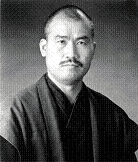
Shinkendo was founded by
Toshishiro Obata (小幡 利城)
Mr. Obata joined the Tokyo Wakakoma (an elite group of martial
artists, who serve as fight scene choreographers, actors and stuntmen for
Japanese television and movies). Through the experience with the Tokyo Wakakoma
and the martial arts connections made during this time, Mr. Obata was able to
seriously study classical sword arts as well as other Budo (Japanese war arts)
while concurrently developing skills as an action coordinator and actor. He was
named Bushido Shihan of the Tate dojo (internal to the Wakakoma) and led
instruction in Bajutsu (archery from horseback),
Yoroi (the wearing of traditional clothing and armor), Yarijutsu (spear) and
Naginata (Japanese halberd).
In 1980, Mr. Obata came to the USA to pursue the development
of his career as an actor and stunt choreographer. After 10 years as the Soke
(Chief Instructor) of the USA Toyama and
Nakamura Ryu Battodo Federation,
Mr. Obata redirected his efforts into developing the fundamentals of the sword
art "Shinkendo" - a system based upon his vast experience, knowledge and
historical research.
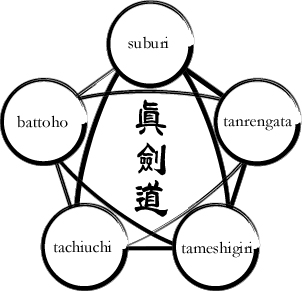
Shinkendo revolves around the structure of Gorin Goho Gogyo.
Gorin Goho Gogyo
are five equally balanced interacting rings that symbolize the five major
methods of technical study. These include Suburi (sword swinging drills),
Tanrengata (Solo forms), Battoho (combative drawing and cutting methods),
Tachiuchi (sparring), and Tameshigiri/Shizan (cutting straw and bamboo targets).
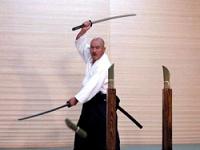
Students of Shinkendo train with a Bokuto, which is a wooden sword. They advance
to training with an Iaito or Mugito, a non-sharpened sword. Finally they use a
Shinken, or a "live blade." At more advanced levels, the student may test his
skill by test cutting practice on tatami omoto makiwara, which are rolled up
tatami mats which were previously soaked in water. Eventually the student test
cuts using Nihondake or Mosodake, Japanese or Chinese bamboo. Test cutting alone
is not the ultimate goal. A full and complete integration of sword and practice
and its concepts should be achieved before students touch a real sword.
Suburi
- Isolating and practicing the basics of ken sabaki
(sword movement), tai sabaki (body movement), ashi sabaki (foot movement), and
toho jussinho (the basic ten sword methods).
Tanrengata
- Solo forms simultaneously utilizing multiple aspects
of suburi with complimentary movements.
Battoho
- Like tanrengata with an emphasis on powerful and
efficient cuts from the draw. Drawing and sheathing is practiced in all
directions.
Tachiuchi
- Paired sparring forms that develop the practitioner's
coordination and ability to harmonize with an opponent. Specifically the
practitioner develops awase (timing), maai (distance to target), hohaba
(balance), rhythm, and kiai.
Tameshigiri/Shizan
- Test cutting with a live blade (a shinken). Typical target
materials include tatami omote and bamboo (either Nihondake or Mosodake - -
Japanese or Chinese Bamboo). Tameshigiri offers practical insight into
principles such as hasuji (edge angles), tachisuji (sword swing-angles), and
tenouchi (grip).