|
|
|
|
|
|
|
|
 |
Bushido, literally translated
"Way of the Warrior," developed in Japan between the Heian and
Tokugawa Ages (9th-12th century). It was a code and way of life for
Samurai. |
|
The
Samurai were
a class of warriors similar to the medieval knights of Europe. It was influenced by Zen and Confucianism,
two different schools of thought of those periods. Bushido is not
unlike the chivalry and codes of the European knights. "It puts
emphasis on loyalty, self sacrifice, justice, sense of shame, refined
manners, purity, modesty, frugality, martial spirit, honor and
affection"
ORIGINS
AND INFLUENCES
Bushido
comes out of Buddhism, Zen, Confucianism, and Shintoism. The
combination of these schools of thought and religions has formed
the code of warrior values known as Bushido.
From
Buddhism, Bushido gets its relationship to danger and death. The
samurai do not fear death because they believe as Buddhism teaches,
after death one will be reincarnated and may live another life here
on earth. The samurai are warriors from the time they become
samurai until their death; they have no fear of danger. Through
Zen, a school of Buddhism one can reach the ultimate
"Absolute." Zen meditation teaches one to focus and reach
a level of thought words cannot describe. Zen teaches one to
"know thyself" and do not to limit yourself. Samurai used
this as a tool to drive out fear, unsteadiness and ultimately
mistakes. These things could get him killed. |
 |
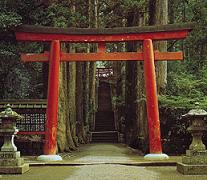 |
Shintoism, another Japanese doctrine, gives Bushido its loyalty and
patriotism. Shintoism includes ancestor-worship which makes the
Imperial family the fountain-head of the whole nation. It awards the
emperor a god-like reverence. He is the embodiment of Heaven on earth.
With such loyalty, the samurai pledge themselves to the emperor and
their daimyo or feudal landlords, higher ranking samurai. Shintoism
also provides the backbone for patriotism to their country, Japan.
They believe the land is not merely there for their needs, "it is the
sacred abode to the gods, the spirits of their forefathers . . ."
(Nitobe, 14). The land is cared for, protected and nurtured through an
intense patriotism. |
|
Confucianism gives Bushido its beliefs in
relationships with the human world, their environment and family.
Confucianism's stress on the five moral relations between master and
servant, father and son, husband and wife, older and younger brother,
and friend and friend, are what the samurai follow. However, the
samurai disagreed strongly with many of the writings of Confucius.
They believed that man should not sit and read books all day, nor
shall he write poems all day, for an intellectual specialist was
considered to be a machine. Instead, Bushido believes man and the
universe were made to be alike in both the spirit and ethics. |
 |
Along
with these virtues, Bushido also holds justice, benevolence, love,
sincerity, honesty, and self-control in utmost respect. Justice is one
of the main factors in the code of the samurai. Crooked ways and
unjust actions are thought to be lowly and inhumane. Love and
benevolence were supreme virtues and princely acts. Samurai followed a
specific etiquette in every day life as well as in war. Sincerity and
honesty were as valued as their lives. Bushi no ichi-gon, or "the word
of a samurai," transcends a pact of complete faithfulness and trust.
With such pacts there was no need for a written pledge; it was thought
beneath one's dignity.
|
|
The samurai also needed
self-control and stoicism to be fully honored. He showed no sign of
pain or joy. He endured all within--no groans, no crying. He held a
calmness of behavior and composure of the mind neither of which should
be bothered by passion of any kind. He was a true and complete
warrior.
|
 |
These
factors which make up Bushido were few and simple. Though simple,
Bushido created a way of life that was to nourish a nation through
its most troubling times, through civil wars, despair and
uncertainty. "The wholesome unsophisticated nature of our warrior ancestors derived ample food for their spirit from a sheaf
of commonplace and fragmentary teachings, gleaned as it were on the
highways and byways of ancient thought, and, stimulated by the
demands of the age formed from these gleanings a new and unique way
of life" (Nitobe, 20). |
|
Bushidō expanded and
formalized the earlier code of the samurai, and stressed frugality,
loyalty, mastery of martial arts, and honor to the death. Under the
bushidō ideal, if a samurai failed to uphold his honor he could regain
it by performing seppuku (ritual suicide).
In the world of the warrior, seppuku was a deed of bravery that was
admirable in a samurai who knew he was defeated, disgraced, or
mortally wounded. It meant that he could end his days with his
transgressions wiped away and with his reputation not merely intact
but actually enhanced. The cutting of the abdomen released the
samurai’s spirit in the most dramatic fashion, but it was an extremely
painful and unpleasant way to die, and sometimes the samurai who was
performing the act asked a loyal comrade to cut off his head at the
moment of agony.
Bushidō was widely practiced, varying little over time, and across the
geographic and socio-economic backgrounds of the samurai, who at one
time represented up to 10% of the Japanese population.The first Meiji
era census at the end of the 19th century counted 1,282,000 members of
the "high samurai", allowed to ride a horse, and 492,000 members of
the "low samurai", allowed to wear two swords but not to ride a horse,
in a country of about 25 million. |
 |
|
Other parts of the
bushidō philosophy cover methods of raising children, appearance, and
grooming, but all this may be seen as part of one's constant
preparation for death—to die a good death with one's honor intact, the
ultimate aim in a life lived according to bushidō. Indeed, a "good
death" is its own reward, and by no means assurance of "future
rewards" in the afterlife. Notable samurai have throughout history
held such aims or beliefs in disdain, or expressed the awareness that
their station—as it involves killing—precludes such reward, especially
in Buddhism. On the contrary, the soul of a noble warrior suffering in
hell or as a lingering spirit is a common motif in Japanese art and
literature. Bushidō, then—while exhibiting the influence of Dao
through Zen Buddhism--is a philosophy in contradistinction to
religious belief, with a deep commitment to propriety in this world
for propriety's sake. |
 |
The Bushido code is
typified by seven virtues:
Rectitude (義 gi)
Courage (勇 yuu)
Benevolence (仁 jin)
Respect (礼 rei)
Honesty (誠 makoto or 信 shin)
Honour (誉 yo)
Loyalty (忠 chuu)
Others that are sometimes added to these:
Filial piety (孝 kō)
Wisdom (智 chi)
Care for the aged (悌 tei) |
|
I. Rectitude or Justice
Bushido refers not only to martial rectitude, but to personal rectitude: Rectitude or Justice, is the strongest virtue of Bushido. A well-known samurai defines it this way: ‘Rectitude is one’s power to decide upon a course of conduct in accordance with reason, without wavering; to die when to die is right, to strike when to strike is right.’ Another speaks of it in the following terms: ‘Rectitude is the bone that gives firmness and stature. Without bones the head cannot rest on top of the spine, nor hands move nor feet stand. So without Rectitude neither talent nor learning can make the human frame into a samurai.’
II. Courage
Bushido distinguishes between bravery and courage: Courage is worthy of being counted among virtues only if it’s exercised in the cause of Righteousness and Rectitude. In his Analects, Confucius says: ‘Perceiving what is right and doing it not reveals a lack of Courage.’ In short, ‘Courage is doing what is right.’
III. Benevolence or Mercy
A man invested with the power to command and the power to kill was expected to demonstrate equally extraordinary powers of benevolence and mercy: Love, magnanimity, affection for others, sympathy and pity, are traits of Benevolence, the highest attribute of the human soul. Both Confucius and Mencius often said the highest requirement of a ruler of men is Benevolence.
IV. Politeness
Discerning the difference between obsequiousness and politeness can be difficult for casual visitors to Japan, but for a true man, courtesy is rooted in benevolence: Courtesy and good manners have been noticed by every foreign tourist as distinctive Japanese traits. But Politeness should be the expression of a benevolent regard for the feelings of others; it’s a poor virtue if it’s motivated only by a fear of offending good taste. In its highest form Politeness approaches love.
V. Honesty and Sincerity
True samurai, according to author Nitobe, disdained money, believing that “men must grudge money, for riches hinder wisdom.” Thus children of high-ranking samurai were raised to believe that talking about money showed poor taste, and that ignorance of the value of different coins showed good breeding: Bushido encouraged thrift, not for economical reasons so much as for the exercise of abstinence. Luxury was thought the greatest menace to manhood, and severe simplicity was required of the warrior class … the counting machine and abacus were abhorred.
VI. Honor
Though Bushido deals with the profession of soldiering, it is equally concerned with non-martial behavior: The sense of Honor, a vivid consciousness of personal dignity and worth, characterized the samurai. He was born and bred to value the duties and privileges of his profession. Fear of disgrace hung like a sword over the head of every samurai … To take offense at slight provocation was ridiculed as ‘short-tempered.’ As the popular adage put it: ‘True patience means bearing the unbearable.’
VII. Loyalty
Economic reality has dealt a blow to organizational loyalty around the world. Nonetheless, true men remain loyal to those to whom they are indebted: Loyalty to a superior was the most distinctive virtue of the feudal era. Personal fidelity exists among all sorts of men: a gang of pickpockets swears allegiance to its leader. But only in the code of chivalrous Honor does Loyalty assume paramount importance.
These are the seven principles underlying the spirit of Bushido,
Bu-martial arts; shi-warrior; do the way.
The way of the samurai is imperative and absolute. Practice, in the
body, through the unconscious, is fundamental to it, thus the enormous
importance attached to the learning of right action or behavior.
Bushido has influenced Buddhism, and Buddhism has influenced Bushido;
the elements of Buddhism found in Bushido are five:
Pacification of the emotions;
Tranquil compliance with the inevitable;
Self-control in the face of any event;
A more intimate exploration of death than of life;
Pure poverty. |
|
|
|
|
|